

Metal spinning.
Expertise that shapes metal.
We manufacture metal components using manual and CNC spinning. Our capabilities also include shear forming, with flow forming and tube shaping used where suitable.
Discuss your componentExplore the processes ↓What is metal spinning?
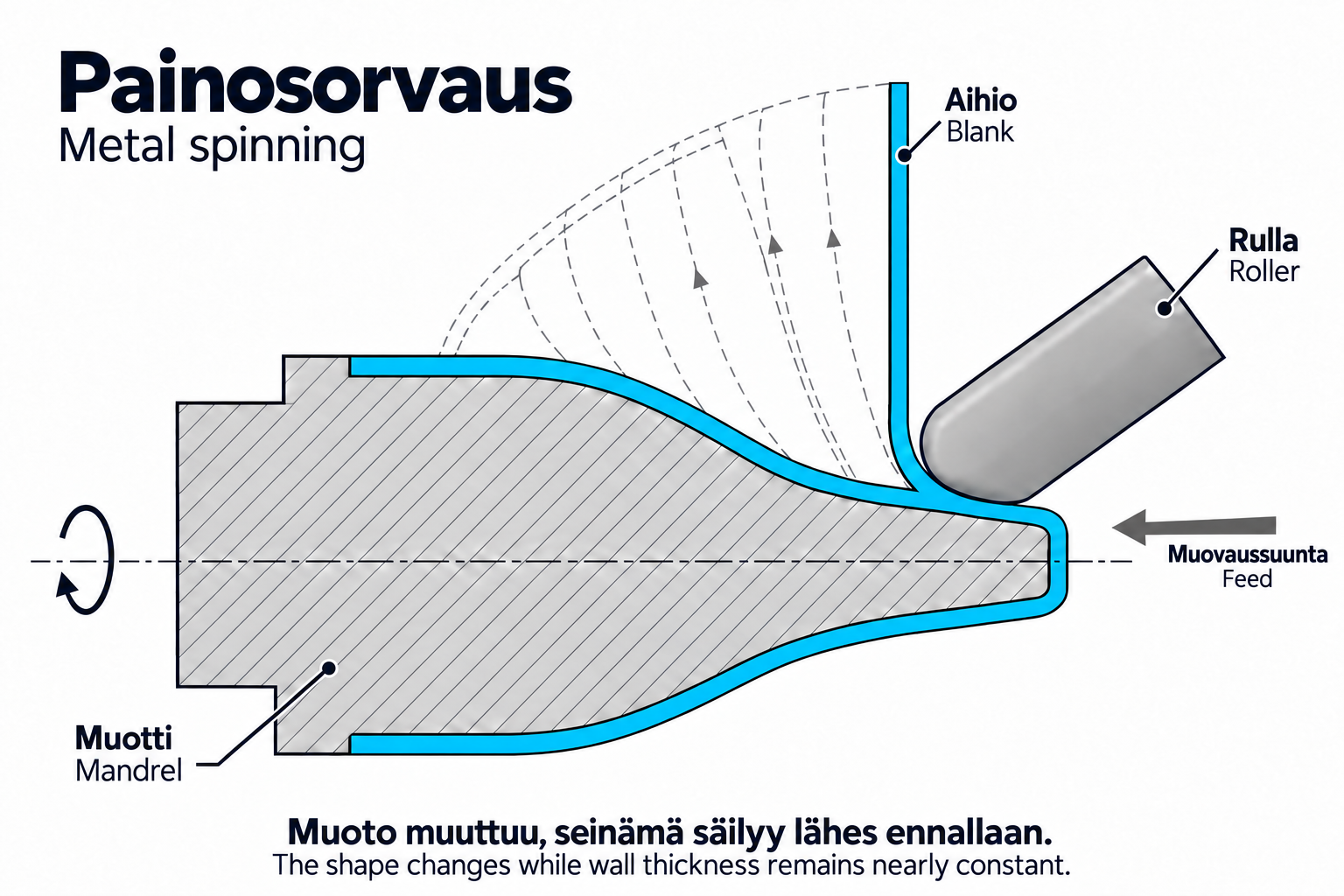
Metal spinning is a forming process in which a rotating sheet-metal blank is shaped against a mandrel using a roller. The mandrel defines the component’s internal shape. Forming takes place progressively over one or more passes.
The shape is produced primarily by deforming the metal rather than removing it. The process is suited to rotationally symmetrical components such as cones, cups, collars, covers and curved shells. Suitable designs can be formed from a single blank, reducing the need for welded joints.
The production method is selected according to the component’s geometry, material, dimensions and batch size. Three different metal spinning techniques are presented below.
Materials and maximum dimensions
The materials we most commonly use for metal spinning include steels, especially deep-drawing grades, galvanised sheet, aluminium, austenitic and ferritic stainless steels, and heat-resistant steels. We also form copper, brass, titanium and other suitable metals.
| Material | Thickness |
|---|---|
| Steel | Approx. 6 mm |
| Stainless steel | Approx. 5 mm |
| Aluminium | Approx. 8 mm |
The maximum rotating diameter is Ø 1,600 mm. Material grade, thickness and component geometry affect manufacturability. The maximum thickness and maximum rotating diameter may not be achievable in the same component. We confirm suitability based on your drawing.
Conventional metal spinning
The blank is formed progressively against a rotating mandrel. Roller paths and forming passes are chosen to suit the material and geometry. The aim is to achieve the required shape without intentionally reducing wall thickness.
The blank’s shape and outside diameter change, while its wall thickness remains broadly close to the starting thickness. Local changes can occur during forming.
The process accommodates straight, conical and curved profiles. The relatively simple tooling makes it a competitive option even for small batches.
Controlled wall reduction
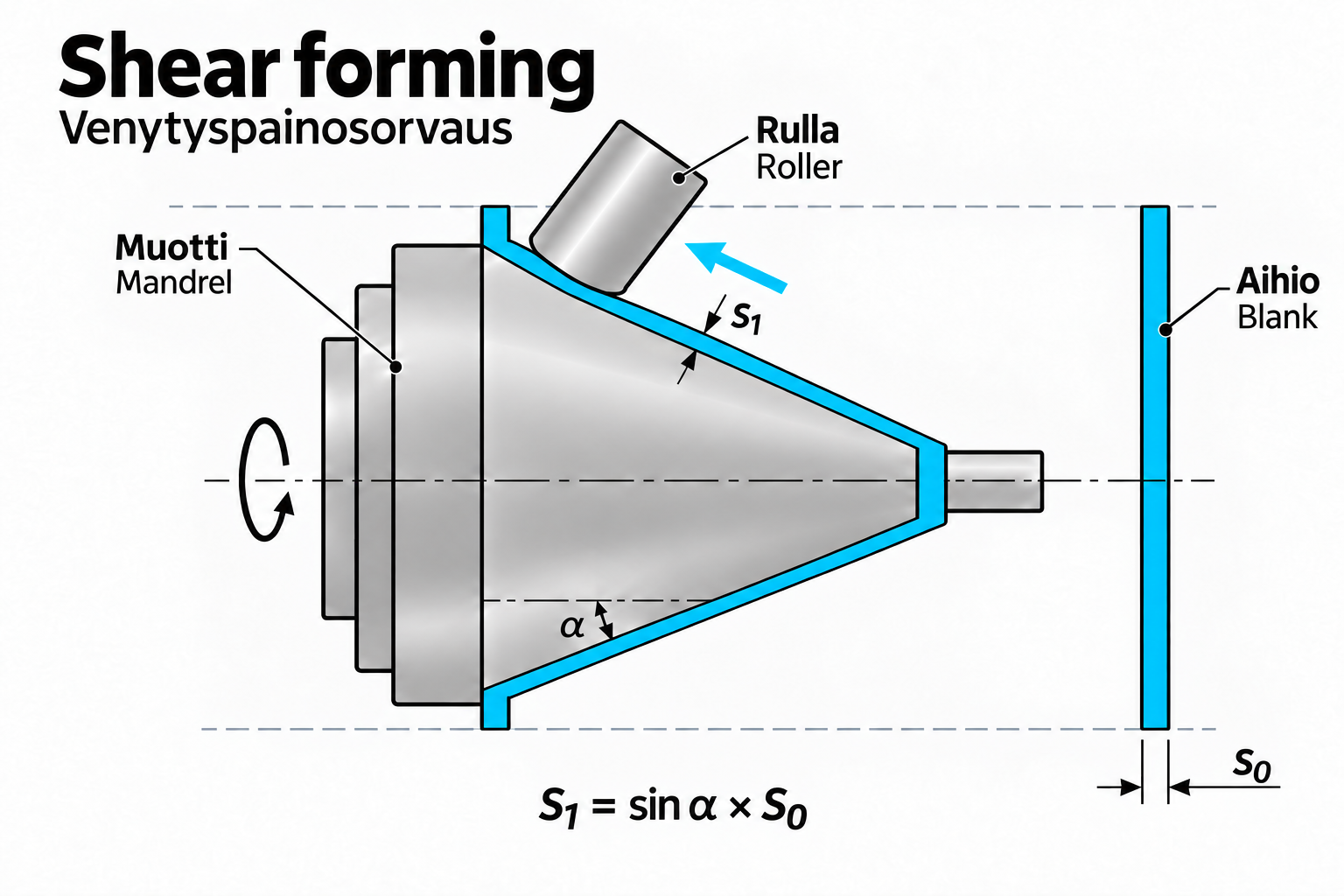
Shear forming is one of the metal spinning processes. A roller shapes the rotating blank against a conical mandrel while deliberately reducing its wall thickness. The blank’s outside diameter is retained in the ideal process.
The wall thickness of a cone can be estimated using the formula S₁ = sin α × S₀, where α is the cone half-angle and S₀ is the starting material thickness.
Shear forming generally provides good surface quality and dimensional accuracy. The process is also suitable for varying conical profiles and curved surfaces. The starting material thickness is assessed based on the component’s geometry and the requirements of the finished product.
Flow forming and tube spinning
In addition to sheet-metal blanks, we also shape tubes by spinning. The possibilities depend on the material, diameter, wall thickness and required geometry.
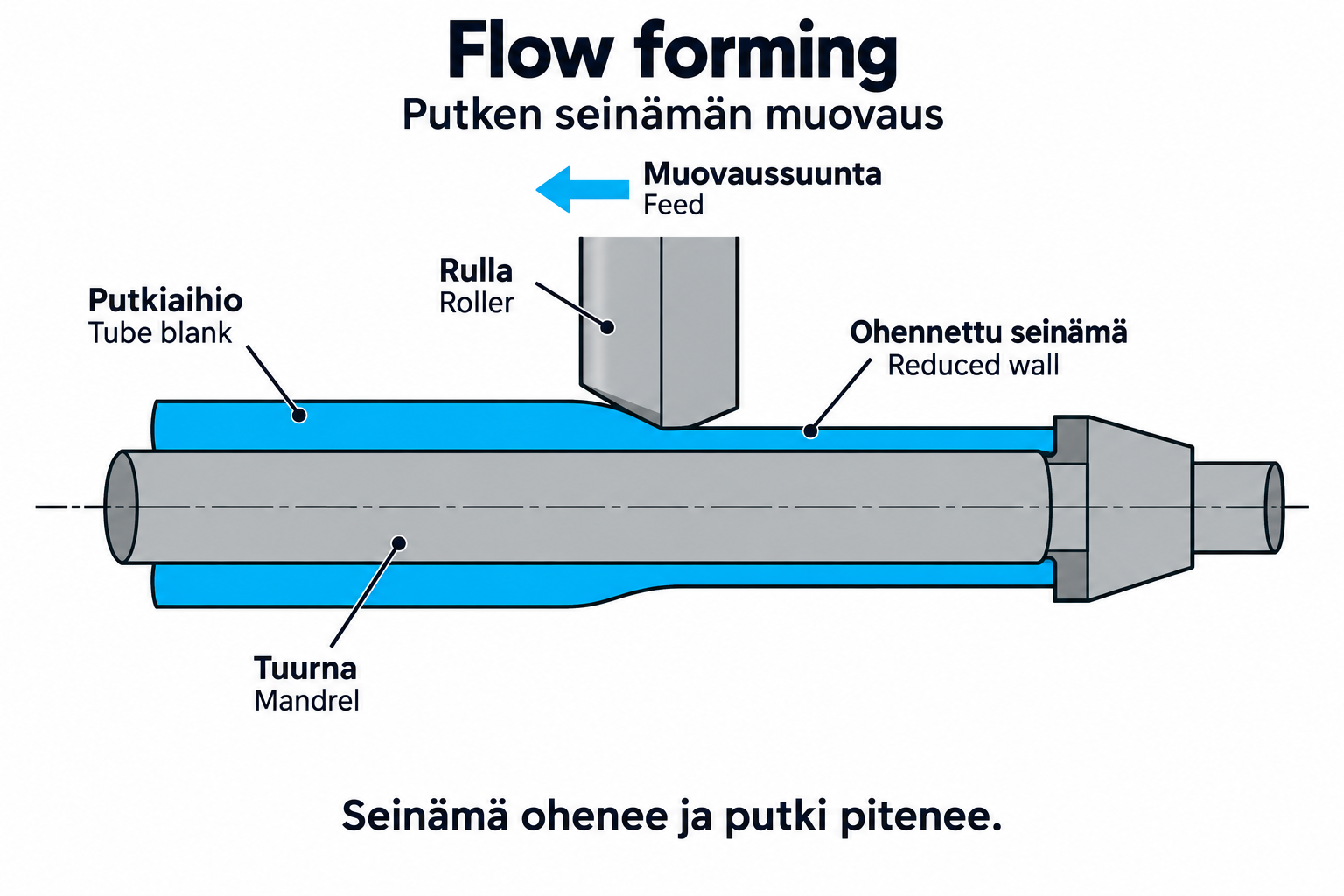
In flow forming, the tube wall is reduced against an internal mandrel. Material moves axially and the tube becomes longer.
We use flow forming where suitable. Tube shaping does not always require wall reduction: the tube end or another section can also be reshaped. We assess the appropriate process using the drawing and material specification.
Manual flexibility. CNC repeatability.
Manual metal spinning
The operator guides the forming tool and monitors how the material behaves. Experience, material knowledge and control of the forming movements are central to the process.
- A flexible option for one-off parts and small batches.
- Suitable for prototypes and developing new shapes.
- The forming process can be adjusted during production.
CNC metal spinning
The forming tool follows programmed movements. Tooling, roller paths and settings developed for the component allow the process to be repeated consistently from part to part.
- Repeatable forming and consistent batch production.
- Programs can be reused for repeat orders.
- Efficient production for suitable batch sizes.
Which process suits your part?
No single process is right for every component. Geometry, material, thickness, tolerances and quantity determine the choice. Different forming techniques can also be combined in the same part. We can help assess manufacturability during the design stage.
Send us your drawing or sketch.
Include the material, thickness, quantity and requested delivery date. We will assess the production method and the information needed for a quotation.